ARUNACHAL PRADESH
There are places you visit, and then there are places that stay with you forever. Arunachal Pradesh belongs to the latter.
Nestled in the northeastern frontier of India, this mystical land is where the first rays of the Indian sun touch the earth, painting the mountains in gold and awakening a silence that feels almost sacred. Here, nature is untouched, traditions are alive, and life flows at a rhythm the modern world has long forgotten.
Arunachal Pradesh is not loud in its beauty—it is deep, quiet, and profoundly moving.
Historical Legacy – A Land Beyond Time
Unlike many regions shaped by empires and invasions, Arunachal Pradesh has preserved a history that is organic and deeply rooted in its people.
Ancient Hindu texts speak of this region as a sacred land. It is believed that Parashurama found redemption here, giving spiritual significance to places like Parashuram Kund.
For centuries, the region remained home to indigenous tribes who lived in harmony with nature, untouched by large kingdoms. During British rule, it was known as NEFA (North-East Frontier Agency), and only in 1987 did it formally become a full-fledged Indian state.
Its history is not written in monuments alone—but in living traditions, rituals, and ways of life.
Arunachal Pradesh spans across the eastern Himalayas, with lush valleys, high mountains, dense forests, and numerous rivers that contribute to the state’s biodiversity. It has some of the highest peaks in India, including Kangto and Nyegi Kangsang. The state is also home to rich wildlife, including the rare red panda, snow leopard, and several species of birds and amphibians.
The state is divided into four broad geographical regions:
Tawang Plateau: The western part of Arunachal Pradesh is dominated by the Tawang Plateau, home to the Tawang Monastery, which is one of the largest Buddhist monasteries in India. This region is also strategically important due to its proximity to the border with China.
Western Arunachal: Known for its beautiful hills and valleys, the region is characterized by the presence of various tribal communities.
Central Arunachal: This area, including the state capital Itanagar, is known for its subtropical climate and the presence of rivers like the Brahmaputra.
Eastern Arunachal: This region borders Myanmar and is covered with thick forests, home to several indigenous tribes. The area is rich in biodiversity.
Culture & Traditions – A Living Heritage
Arunachal Pradesh is home to over 25 tribes, including the Apatani Tribe, Nyishi Tribe, and Monpa Tribe.Each tribe has its own
- Language and attire
- Rituals and beliefs
- Festivals and celebrations
Cuisine – Pure, Simple, Authentic
Food here mirrors the land—natural and unpretentious.
- Rice is the staple
- Bamboo shoot is widely used
- Smoked meats and local herbs define flavors
The focus is not on spice, but on retaining the essence of ingredients.
Climate & Best Time to Visit
Arunachal Pradesh offers varied climatic experiences:
- Cool and pleasant valleys
- Snow-covered high-altitude regions
- Heavy monsoon rains
Best time to visit: October to April, when the skies are clear and landscapes are at their most beautiful.
FESTIVALS
In this culturally rich northeastern state, festivals are deeply rooted in tribal traditions, agricultural cycles, and spiritual beliefs.
Among the most vibrant is Losar, celebrated by the Monpa tribe, marking the Tibetan New Year with prayers, dances, and joyful gatherings. Equally significant is Solung, observed by the Adi community to seek prosperity, good harvest, and protection from evil spirits.
The Apatani tribe celebrates Dree Festival, praying for fertility of crops and harmony in life, while the Nyishi tribe’s Nyokum Festival reflects a deep connection with nature and the divine.
TEXTILES
The textiles of Arunachal Pradesh are not merely fabrics—they are woven expressions of identity, tradition, and storytelling. Every tribe in the state carries its own distinct weaving style, where patterns, colors, and motifs reflect lineage, beliefs, and the natural world around them.
Among the most admired are the intricate weaves of the Adi Tribe, known for their bold geometric designs and vibrant color combinations. The Apatani Tribe create elegant, understated textiles with fine detailing, while the Monpa Tribe produce warm woollen fabrics suited to the colder regions, often influenced by Tibetan styles.
CRAFTS
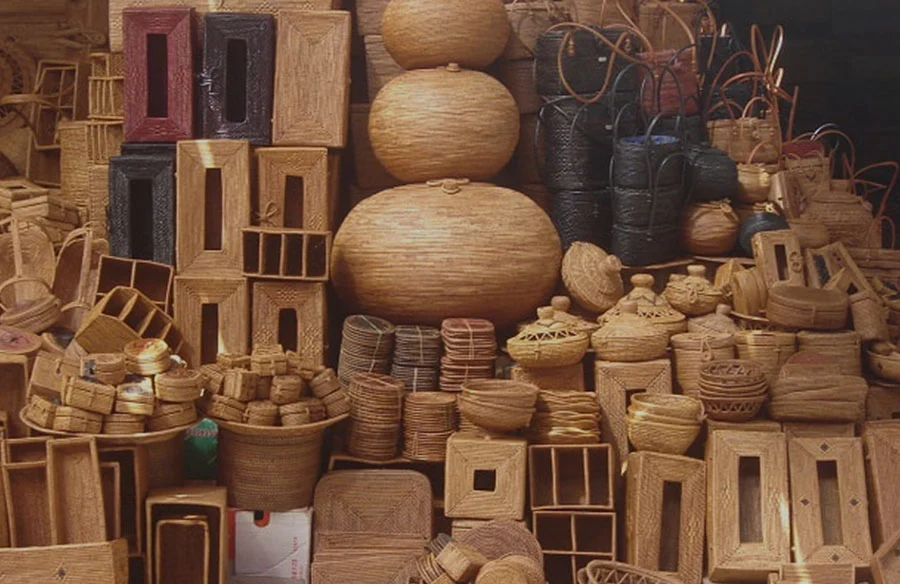
Communities like the Monpa Tribe are known for their finely carved wooden items and traditional masks used in religious dances, while the Nyishi Tribe create beautiful cane and bamboo products—ranging from baskets to utility items that blend function with artistry. The Adi Tribe are also renowned for their craftsmanship in bamboo work and handmade ornaments.
Bamboo, cane, wood, and natural fibers form the backbone of these crafts, making them eco-friendly and sustainable. Every item—whether a basket, mat, ornament, or ceremonial object—is created with a purpose, often reflecting the lifestyle and environment of the people.
DANCE
Among the most captivating is the Ponung Dance, performed by the Adi tribe, where women move gracefully in coordinated steps while hymns narrate tales of creation and culture. Equally powerful is the Aji Lamu Dance, a dramatic performance featuring masks and elaborate costumes, depicting mythological stories and spiritual themes.
The Roppi Dance reflects strength and valor, performed with energetic movements that echo the tribe’s warrior traditions. Similarly, dances across tribes often celebrate harvests, invoke blessings, or mark seasonal changes.
What Makes Arunachal Pradesh Special
🌅 First sunrise in India
🌿 One of the least explored and most pristine states
🧘 Deep spiritual and monastic culture
🧬 Extraordinary tribal diversity
🛡️ A proud and strategic frontier of India