
Politics & Governance


ADMINISTRATION
Administration in India encompasses the principles, institutions, and practices through which governance, public services, and civic affairs have been organized and managed across different periods of history. From ancient systems of local governance and imperial administration to the institutions of the modern Republic, India’s administrative traditions reflect evolving approaches to public welfare, justice, resource management, and effective governance. The study of administration offers valuable insights into the structures and processes that have shaped the nation’s development.

DIPLOMACY
Diplomacy examines the art and practice of managing relations between states through dialogue, negotiation, cooperation, and strategic engagement. In the Indian context, it encompasses a rich tradition of diplomatic thought, international relations, treaty-making, and foreign policy extending from ancient kingdoms to the modern Republic. The study of diplomacy provides insights into India’s interactions with the wider world and its evolving role in regional and global affairs.
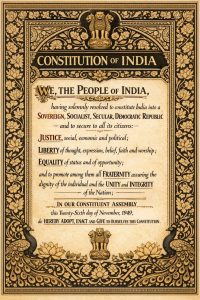
CONSTITUTION
The Constitution of India is the supreme law of the nation, establishing the framework for governance, the distribution of powers, fundamental rights, directive principles, and the responsibilities of institutions and citizens. Adopted in 1950, it embodies the democratic ideals, constitutional values, and aspirations of an independent India while providing the legal foundation for justice, liberty, equality, and fraternity. The study of the Constitution offers a deeper understanding of India’s legal, political, and institutional framework.

PUBLIC POLICY
Public Policy examines the processes through which governments formulate, implement, and evaluate decisions that address public needs and national priorities. In India, it encompasses a wide range of areas including governance, education, healthcare, economic development, environmental sustainability, social welfare, infrastructure, and public administration. The study of public policy provides valuable insights into how evidence, institutions, law, and public participation shape the nation’s development and the well-being of its citizens.