The Aranyakas are a significant group of ancient Sanskrit texts that form an integral part of the Vedic corpus, serving as a bridge between the ritual-focused Brahmanas and the philosophical insights of the Upanishads. Traditionally associated with contemplation and spiritual inquiry, they explore the symbolic meaning of Vedic rituals and the deeper relationship between the individual, nature, and the sacred. The Aranyakas provide valuable insights into the evolution of India’s philosophical and spiritual thought.
The Brahmanas are ancient Sanskrit prose texts associated with the Vedas that explain the significance, procedures, and symbolism of Vedic rituals and sacrificial ceremonies. They provide detailed interpretations of ritual practices while exploring their philosophical, theological, and cosmological dimensions. As foundational works of Vedic literature, the Brahmanas offer invaluable insights into the religious thought, social life, and intellectual traditions of ancient India.
Classical Sanskrit Literature represents one of the world’s richest literary traditions, encompassing poetry, drama, epics, philosophy, science, grammar, aesthetics, law, and devotional works composed over many centuries. Renowned for its linguistic refinement, literary excellence, and intellectual depth, this vast body of literature has profoundly influenced India’s cultural, philosophical, and artistic heritage. Its timeless works continue to inspire scholars, writers, and readers across the world.
Commentaries are scholarly works that explain, interpret, and illuminate the meaning of classical texts, making them more accessible to students, scholars, and practitioners. In the Indian tradition, commentarial literature has played a central role in preserving and transmitting knowledge across disciplines such as philosophy, grammar, literature, law, medicine, and spirituality. These works enrich the understanding of foundational texts while reflecting centuries of intellectual dialogue and scholarly inquiry.
India’s epics are among the greatest literary and cultural treasures of its civilization, weaving together history, philosophy, ethics, spirituality, and timeless human values through grand narratives. These monumental works have shaped the moral imagination, artistic traditions, and cultural identity of generations while inspiring literature, performing arts, and religious practice across the Indian subcontinent. Their enduring relevance continues to make them a cornerstone of India’s literary and intellectual heritage.
The Puranas are a vast collection of Sanskrit texts that preserve India’s sacred narratives, cosmology, genealogy, philosophy, pilgrimage traditions, and cultural history. Through engaging stories of deities, sages, kings, and great events, they communicate spiritual teachings and ethical values while preserving centuries of religious and cultural knowledge. The Puranas remain an invaluable source for understanding India’s rich mythological, historical, and devotional traditions.
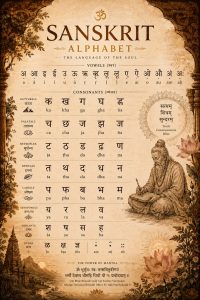
Sanskrit Grammar is one of the most sophisticated linguistic traditions in the world, providing a systematic framework for understanding the structure, usage, and precision of the Sanskrit language. Developed through centuries of scholarly inquiry, it encompasses phonetics, morphology, syntax, semantics, and linguistic analysis. The study of Sanskrit grammar serves as the foundation for interpreting classical texts and appreciating the remarkable intellectual achievements of India’s grammatical tradition.
Sanskrit Learning encompasses the study and teaching of one of the world’s oldest and most influential classical languages. It includes grammar, vocabulary, pronunciation, literature, conversation, translation, and the interpretation of classical texts across diverse disciplines. Learning Sanskrit provides direct access to India’s vast intellectual heritage, enabling readers to engage with original works in philosophy, science, medicine, mathematics, literature, and spirituality.
The Smritis are an important body of Sanskrit literature that elaborates on principles of ethics, law, social conduct, and religious practice within the broader framework of the Hindu tradition. Drawing upon the authority of the Vedas while addressing practical aspects of individual and societal life, these texts have significantly influenced legal thought, social institutions, and cultural practices across different periods of Indian history. They remain valuable sources for understanding India’s intellectual and legal heritage.
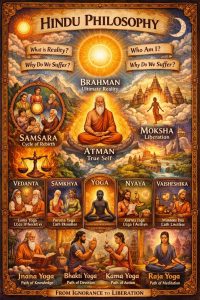
The Upanishads are among the most profound philosophical texts of India’s spiritual tradition, exploring the nature of reality, consciousness, the self (Atman), and the ultimate truth (Brahman). Forming the concluding portion of the Vedic corpus, they emphasize inquiry, contemplation, and self-realization as pathways to wisdom and liberation. Their timeless teachings have profoundly influenced Indian philosophy and continue to inspire thinkers, scholars, and spiritual seekers around the world.
The Vedangas are six auxiliary disciplines developed to support the proper study, preservation, interpretation, and recitation of the Vedas. Covering subjects such as phonetics, grammar, etymology, prosody, ritual practice, and astronomy, they provide the essential scholarly framework for understanding Vedic literature. Together, the Vedangas represent the remarkable depth and systematic nature of India’s ancient educational and intellectual traditions.
The Vedas are the oldest and most revered sacred texts of the Indian tradition, forming the foundation of its spiritual, philosophical, and cultural heritage. Composed in Sanskrit and transmitted through an extraordinary oral tradition, they encompass hymns, rituals, philosophical reflections, and sacred knowledge that have shaped Indian thought for millennia. As one of humanity’s oldest literary traditions, the Vedas continue to be studied for their profound insights into spirituality, language, culture, and the evolution of Indian civilization.
India has countless stories to tell. We’re just getting started.
India has over 5,000 years of stories, traditions and craftsmanship. Bringing them together is a journey—and we’re delighted that you’re joining us from the very beginning.
Because India’s treasures are vast and thoughtfully curated, our collection will continue to grow every single day. New products, new collections and new discoveries are being added regularly from different parts of the country.
We invite you to return often—there will always be something new waiting to be discovered.
Thank you for being among the first to begin this journey with us.







 Archaeology
 Art
Art
 Indian Architecture
 Indian Philosophy
 Literature of India
 Society & Anthropology
 Temple Architecture